
 Blog Ideas The Best Model Context Protocol Implementation Companies in 2026 (Now That MCP Has Grown Up)
The Best Model Context Protocol Implementation Companies in 2026 (Now That MCP Has Grown Up)
MCP just had its awkward teenage year, and it shows in the data. Any model context protocol implementation company worth hiring in 2026 now has to answer for a lot more than basic connectivity: the protocol hit 110 million monthly SDK downloads by April 2026 — a milestone React took roughly three years to reach, that MCP hit in 16 months. It also spent 2026 absorbing a very public “is MCP dead?” debate, a disclosed remote-code-execution design weakness, and Perplexity’s CTO announcing the company was moving away from MCP over context-window overhead. None of that killed the protocol. It just ended the phase where anyone could bolt an MCP server onto a side project and call it done.
The April 2026 MCP Dev Summit made the shift obvious: of roughly 95 sessions across four tracks, security was the single most represented theme, with 23 dedicated sessions — more than any capability demo got. That ratio tells you where the real work moved. Analyses following the summit kept surfacing the same finding: organizations consistently discover several times more MCP servers running inside their infrastructure than IT ever approved — informally called “Shadow MCP,” and it’s created compliance gaps nobody budgeted for. OAuth 2.1 authentication, once optional, is now part of MCP’s own roadmap as a top-four priority for exactly this reason.
What that means for anyone hiring an implementation partner in 2026: the bar isn’t “can you connect an LLM to an API.” It’s whether the company you hire treats auth, audit trails, and governance as core deliverables — not something to retrofit after a Shadow MCP audit finds the problem for you.

Table of contents
1. Boldare

Boldare’s edge in 2026’s more security-conscious MCP landscape is that governance was never an afterthought in its approach to begin with. The company’s Agentic AI Implementation practice already builds toward the exact things the market spent this year discovering it needed: audit logging on every action an agent takes, access scopes that prevent an MCP-connected system from exposing more than it should, and human-in-the-loop checkpoints at the decisions that carry real risk. That’s the governance layer most vendors are now scrambling to add after the summit’s security sessions made clear it wasn’t optional.
Boldare’s MCP Server Development work treats the OAuth 2.1 requirement and tenant isolation as baseline, not upsell, and pairs it with LLM Integration & API Development so the servers being built actually connect to a coherent generation layer rather than sitting as an isolated integration project. For organizations auditing their infrastructure post-Shadow-MCP and realizing they need a partner who won’t need a second engagement six months later to bolt on the security they should have had from day one, that baseline matters more in 2026 than it did in 2025.
Boldare’s relevant service lineup:
- MCP Server Development — governed servers built with OAuth 2.1 and tenant isolation as standard, not add-ons
- Agentic AI Implementation — audit logging, access scopes, and human-in-the-loop controls
- LLM Integration & API Development — connecting MCP infrastructure to a working generation layer
- AI Product Development & Consulting — scoping which systems should be exposed, and to what degree
- Legacy Code Modernization with AI — safely wrapping older systems before they’re exposed to agents
- Vibe Coding Sprint — validating an MCP approach on one domain before a full rollout
Best for: Organizations that want MCP governance built in from the start, not retrofitted after a security review.Location: Gliwice, Poland
2. Cazton
Cazton brings unusually deep ecosystem access to MCP work — the firm has worked closely with Microsoft and OpenAI teams since GPT-3’s earliest access period in 2020, well before ChatGPT existed. That relationship shows up in Cazton’s multi-modal approach: implementing MCP across voice, text, image, and video workflows rather than treating it as a text-chatbot-only integration. Their client roster (Microsoft, Google, Bank of America, Dell among others) points toward enterprise-scale engagements as their sweet spot.
Best for: Enterprises already deep in the Microsoft/Azure ecosystem needing multi-modal MCP implementation.
3. mcp-agency.com

mcp-agency.com is a rarity in this space: a company built exclusively around MCP, rather than treating it as one service line among many. That focus shows in the specificity of what they offer — official SDK implementations across TypeScript, Python, C#, Go, PHP, and Rust, OAuth2/OIDC integration with external identity providers, and containerized Docker/Kubernetes delivery — packaged into published, fixed-scope tiers rather than an open-ended consulting engagement. For a company deciding whether to validate MCP with one domain before going further, that transparency is unusually useful.
Best for: SMBs wanting a fixed-scope, transparently priced MCP pilot without a lengthy consulting sales cycle.
4. Bitcot
Bitcot, led by a 15-year veteran of enterprise software delivery for clients including IBM, Sony, and Nissan, positions MCP implementation as inseparable from business strategy rather than a pure technical exercise. Their stated methodology emphasizes aligning MCP adoption with competitive advantage, not just technical correctness — a useful corrective in a market where, as Bitcot itself notes, over 100 vendors now claim MCP implementation experience and not all of them have actually operated a production deployment.
Best for: Businesses that want MCP framed as a strategic initiative with clear ROI, not just a technical integration project.
5. Softude
Softude folds MCP creation into a broader enterprise AI development stack, applying a structured methodology that starts with business goals and contextual layers before writing any integration code. Their cross-industry experience — healthcare, manufacturing, fintech, retail — gives the team a working sense of how MCP requirements differ by sector, which matters because a healthcare compliance context and a retail inventory context need very different governance assumptions baked into the same protocol.
Best for: Cross-industry enterprises that need MCP requirements translated correctly for their specific regulatory context.
6. Quytech

Quytech’s MCP work centers on custom LLM integration for applications like virtual assistants and AI copilots, with a specific emphasis on contextual mapping — folding business workflows, domain-specific data, brand voice, and user intent into the protocol layer rather than treating MCP as pure plumbing. That framing suits companies whose MCP project is really about making a customer-facing AI assistant behave consistently, not just technically functional.
Best for: Customer-facing AI assistants and copilots that need MCP tuned for consistent, on-brand behavior.
7. Rapid Innovation
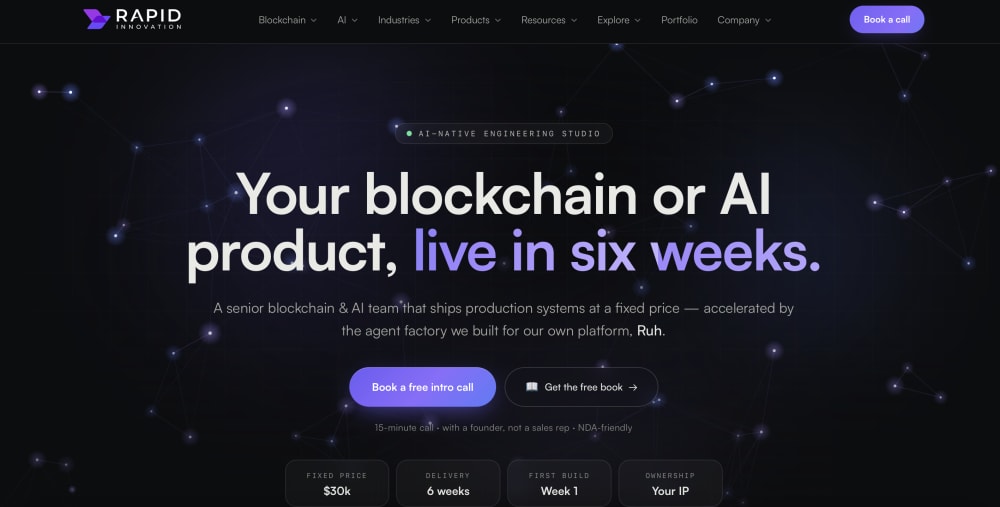
Rapid Innovation works at Fortune 500 scale, with a stated focus on MCP’s full host-client-server architecture and base protocol communication rules rather than a simplified subset. Their pilot work spans healthcare, finance, and e-commerce, and the firm pairs implementation with proprietary monitoring and optimization tooling meant to keep an MCP deployment tuned after launch rather than treating go-live as the finish line.
Best for: Large enterprises needing full-architecture MCP implementation with dedicated post-launch optimization.
What changed in MCP implementation this year
A few things worth checking against any partner’s pitch in 2026 specifically:
- Ask how they handle OAuth 2.1. It’s now part of MCP’s own roadmap, not an optional add-on. A partner still treating auth as a “phase two” conversation is behind where the protocol itself has moved.
- Ask about Shadow MCP. Can they audit what MCP servers already exist in your environment, approved or not? Most organizations find several times more than IT expected.
- Check their answer on the RCE disclosure. A partner who can explain what the April 2026 remote-code-execution design weakness actually was, and how their implementations avoid it, has been paying attention. One who hasn’t heard of it hasn’t been keeping up with the protocol they’re implementing.
- Ask why MCP over a direct API call for your specific use case. Perplexity’s move away from MCP was driven by context-window overhead for a narrow, high-volume use case — not a broad indictment. A good partner can tell you honestly when MCP is or isn’t the right layer for what you’re building.
FAQ
Is MCP still worth adopting in 2026 given the “is MCP dead” debate?
Yes, for the use cases it was built for. The backlash comes mostly from solo developers optimizing personal coding-agent workflows, where a direct API call is genuinely simpler. For teams of 10+ engineers running multiple agent frameworks that need shared telemetry and governance, MCP’s value proposition hasn’t changed — the protocol is maturing into infrastructure, not failing.
What’s the RCE vulnerability everyone’s talking about, and should it change our plans?
In April 2026, a design weakness was disclosed that could enable arbitrary command execution on systems running a vulnerable MCP implementation. It’s a reason to vet how a potential partner handles security, sandboxing, and permission scoping — not a reason to avoid MCP altogether. Ask any vendor directly how their implementation approach addresses it.
Share this article: